

Describe the 3D page you want. Get working Three.js code, not a guess.
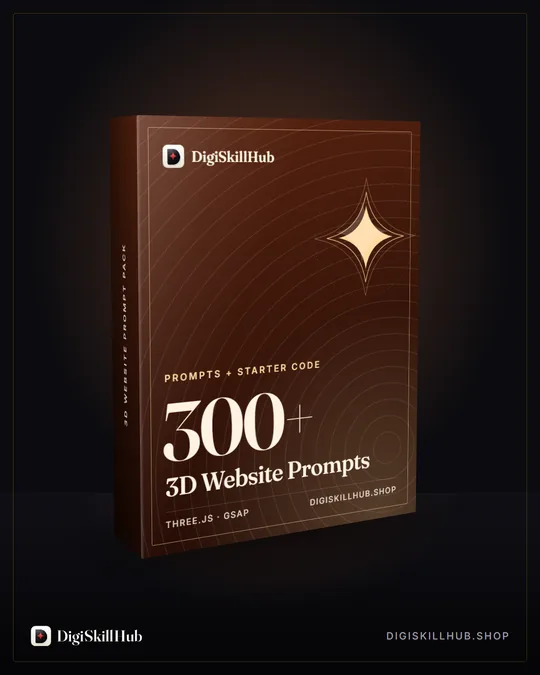
329 prompts in 17 chapters, covering Three.js scenes, lighting, materials, product viewers, scroll-driven 3D, shaders, mobile speed and accessibility, with three small working starter pages.
- 329 original prompts in 17 chapters: scene setup, lighting, materials, camera paths, product viewers, scroll with GSAP ScrollTrigger, particles, shaders, backgrounds, 3D text, interactions, mobile performance, accessibility, debugging, deployment
- A short guide on how to brief an AI assistant for 3D work, with a reusable instruction block and a six step worked example
- Three working starter pages in plain HTML: an orbit product stage, a scroll story and a particle and shader backdrop. Tested in headless Chromium with zero console errors
- Debugging prompts for the problems that stop most people: black screens, missing models, washed out colours, jumpy scroll, hot phones
- PDF (45 pages, searchable), Markdown and CSV. No framework, no build step
- Founding-member price for the first 100 buyers. Launch price ends 07 December 2026
Stripe secure checkout
We read 3,388 comments under other creators' videos before we built this.
Of the 185 that mentioned price, 29 complained about monthly subscriptions and 51 asked for something free.
The problem this solves
- You ask an AI assistant for a 3D web page and get code that shows a black screen.
- Tutorials assume a framework, a build tool or a lot of mathematics.
- Your 3D page looks good on your computer and runs hot or stutters on a phone.
- You are not sure what to ask for, so you ask for something vague and get something vague.
- A scene on screen within the first hour, built from a starter page that already runs.
- A way to ask for lighting, materials, camera moves and scroll effects in words the assistant follows.
- A page that is fast on phones, readable and respects people who turn motion off.
- A checklist to run before you publish.
This is for you if
- You want ready-made files you can use this week.
- You prefer one payment to a monthly bill.
This is not for you if
- You want a promise of income. We make none.
- You want live coaching or a done-for-you service.
- You will not use files you download.
What is inside
The pack works in three layers. The guide teaches how to brief an assistant: the outcome, the stack and versions, the constraints, your existing code and the check you will run. The three starter pages give you something real to build on, so prompts that say 'my scene' have a scene to point at. The 329 prompts then change one thing at a time: a light, a material, a camera path, a scroll timeline, a shader, a performance cap. Smaller steps mean smaller mistakes, and the debugging chapter shows how to ask when a step fails.
Prompts: 329
Original prompts in 17 chapters, with [placeholders] for your details
How to use these prompts: 9 pages
Setup, the anatomy of a good 3D prompt, a reusable instruction block, a worked example, a glossary, performance and accessibility rules and a pre-publish check
Starter pages: 3
Orbit product stage, scroll story with GSAP, particles with a shader backdrop. Plain HTML, Three.js 0.160.0 and GSAP 3.13.0 from public CDNs, no third-party models or images
PDF: 45 pages
Searchable, with a contents page and a bookmark for every chapter
Markdown and CSV files
The same prompts to copy from and filter. CSV columns: id, chapter, title, prompt
Licence
Use for your own sites and your clients' sites. No resale of the pack
From payment to using it, in three steps
Pay once
Card, Apple Pay or Google Pay. You get a invoice. No subscription follows.
Download
The file appears in My Library at once. Download it as often as you need.
Use it
Open it, adapt it to your work, keep it. No monthly meter.

Arjun Murthy
Runs DigiSkillHub
- More than 15 years building artificial intelligence (AI), machine learning, embedded vision and real-time systems
- Leads a software division
- Completed the Advanced General Management Programme (AGMP) at IIM Ahmedabad
I am Arjun Murthy. I build artificial intelligence and embedded-vision systems for a living, more than 15 years of it, and I did the AGMP at IIM Ahmedabad. I build real-time vision and graphics software, and I use these methods when I build 3D pages for my own products: pinned versions, a capped pixel ratio, reduced motion support and a test in a headless browser before anything ships. I wrote every prompt in this pack myself, from how I brief and test AI systems at work. No prompt is copied from another collection.
Why one payment
| Monthly subscription tools | DigiSkillHub | |
|---|---|---|
| What you pay | A fresh payment every month | One payment per product |
| If you stop paying | Access ends | Your downloads stay yours |
| Limits | Credits and caps that run out | Files with no usage meter |
| What people told us | 29 of 185 price comments we read were about subscriptions | Built for exactly that complaint |
Source: comments under competitors' AI-video and digital-product reels and videos on Instagram, Facebook and YouTube, read in November 2026.
3D Website Prompt Pack: Build Immersive Sites with AI
- Founding price $9 for the first 100 buyers (100 left)
- Launch price $12 until 07 December 2026
- Regular price $15 after that
No hidden charges.
Get the 3D Prompt PackWhat you can count on
- Secure paymentStripe: card, Apple Pay and Google Pay. We never see or store your card.
- InvoiceA proper invoice for every order, in My Library.
- Instant downloadYour files appear in My Library as soon as payment clears.
- 7-day refundNot what you expected? Write to us within 7 days. Refund policy.
- Support[email protected]. We reply within 24 to 48 hours.
- Who sells thisDigiSkillHub, No. 33, 131/1, 1st Cross, Shastha Layout, Rayasandra, Bengaluru, Karnataka 560099, India. Contact.
7-day refund
Open the guide, run a starter page and try a few prompts. If it is not what you expected, ask for a refund within 7 days and you get the full amount back.
Questions people ask
What exactly do I download?
One ZIP with a 45-page searchable PDF containing the guide and 329 prompts, the same prompts as Markdown and CSV, a starter-code folder with three working pages, a README and the licence.
Do I need to know how to code?
Not to start. You need to open a folder, run a local server with one command and describe what you see. The guide explains the setup, and the prompts are written for an AI assistant that writes the code. Reading the starter pages teaches the rest.
Do the starter pages need internet?
Yes, the first time. They load Three.js 0.160.0 and GSAP 3.13.0 from public content delivery networks. The prompts in chapter 15 explain how to host those files yourself.
Are the 3D models included?
No. The starters build their objects in code and contain no third-party models, photographs or textures. The product viewer prompts are written for your own models, and chapter 5 has a checklist for confirming you have the right to use one.
Will my page be fast on phones?
The starters cap the pixel ratio, pause when the tab is hidden and respect reduced motion, and a whole chapter covers phone performance. Speed still depends on your assets and your device targets, so test on real phones.
Which AI tools do these work with?
Any assistant that takes a written instruction: ChatGPT, Claude, Gemini and similar. The prompts are plain text, so they do not depend on one product. A paid plan of your assistant may be useful for long work, and that cost is yours.
Will this guarantee results?
No. The prompts give a good first draft and a clear structure. The quality of what you get still depends on the details you put in the brackets and on checking the output yourself.
Can I resell the prompts?
No. You may use them for your own work and your clients' work. You may not resell, share or publish the pack, or a lightly edited copy of it, as a pack of your own.
What if it is not what I expected?
Write to us within the refund window shown at checkout and we refund you.